Your Business Should Be As Smart As You Are.
Client Intelligence is the brain your business runs on, and the agents that run on it.
Free Agent Analysis
Find out which agent your business should build first.
AI Was Supposed To Make Your
Life Easier. It Didn't.
You were told AI would change everything. And it has. Just not the way you expected.
You've got Claude in one tab, ChatGPT in another, client files in Drive, SOPs in Notion, and your frameworks in your head. It doesn't work, and you know it doesn't work. You repeat yourself constantly, you lose decisions you made two weeks ago, and every attempt at an "agent" or a "workflow" reminds you that you didn't start a business to become an AI engineer.

But the tools are the small problem. While you were wrestling with them, the rules changed. For your entire career the deal was simple: get good, then charge for it. Expertise took a decade to build, so it was scarce, and scarce commanded a premium.
That deal is gone. Someone with a twenty dollar subscription and none of your experience now produces something that looks 80% like your work, in an afternoon, at a twentieth of your price. Is it as good as yours? No. Is it good enough that your clients started asking why they're paying you? Yes. The moat you spent ten years digging got filled in a single product cycle.
You were told AI would change everything. And it has. Just not the way you expected.
You've got Claude in one tab, ChatGPT in another, client files in Drive, SOPs in Notion, and your frameworks in your head. It doesn't work, and you know it doesn't work. You repeat yourself constantly, you lose decisions you made two weeks ago, and every attempt at an "agent" or a "workflow" reminds you that you didn't start a business to become an AI engineer.
But the tools are the small problem. While you were wrestling with them, the rules changed. For your entire career the deal was simple: get good, then charge for it. Expertise took a decade to build, so it was scarce, and scarce commanded a premium.
That deal is gone. Someone with a twenty dollar subscription and none of your experience now produces something that looks 80% like your work, in an afternoon, at a twentieth of your price. Is it as good as yours? No. Is it good enough that your clients started asking why they're paying you? Yes. The moat you spent ten years digging got filled in a single product cycle.
Every Business Has A Brain. Most Are Just Fragmented.
Yours already has one. Some of it lives in your head. Some in your best person's habits. Some in Notion, some in Drive, some in a thousand Slack threads and old proposals. There is no single place where what's true, what's decided, and how you do things actually lives. Except you.
You're the source of truth. Which makes you the decision-maker, and the bottleneck. Every answer in your business routes through your head. That was always inefficient. It only became fatal when the world started moving at AI speed, because a business that thinks through one skull can only move as fast as that skull.

In Your Head
unwritten
Across Processes
undocumented
Across Software
v4, maybe
Across People
walks out
Across Platforms
v7, maybe
One brain. Five places. No agreement.
And if part of you is wondering how someone like you ended up behind on this, stop. It isn't your fault: the game changed from figuring things out to having infrastructure, and no amount of smart compensates for infrastructure that doesn't exist. Every tool you tried was bolted onto a fragmented brain. It had nothing coherent to plug into.
The tools were never the problem. The fragmentation is.
Last Year, My Business Had Nearly 100%
Client Retention. This Year...

Great clients, great relationships, work I was proud of. By March of this year, a third of those clients had paused or reworked their payments. By April, 38% were gone.
I wasn't getting worse at the work. The ground had moved. And while I was holding my business together the way every entrepreneur does, in my head, everything sped up past what one head can hold.
But here's what I noticed while it was happening, the thing that changed how I see everything: the leverage had flipped. For twenty years, the worst thing you could scale was a service business, because scaling services meant scaling people. Courses and coaching were the leverage plays. AI inverted that overnight. Suddenly it was easier and cheaper to deliver and scale servicesthan anything else. If, and only if, you could run many clients through AI without everything coming unglued, and without fifty clients' data sloshing around in one chat account.
So I went looking for the infrastructure. A centralized brain, everything in my head in one place, once, with a sealed world for each client that the brain could work on. Simple idea. Should exist.
It didn't.
I told my operator I'd have a solution by end of day. At three in the morning I was still digging through Reddit threads and YouTube comments, watching smart people describe the same two problems, fragmentation and data isolation, and the same non-answer: duct tape. Five tools. Copy, paste, pray.
That's the night Client Intelligence was born. I built it because I needed it. Turned out everyone like me needed it too. What we built, and why it works, is the rest of this page.
Josh Forti, Founder, Client Intelligence
10 minutes · free · know your first agent
There Are Now Two Kinds
Of Businesses.
From the outside they look identical. Same services, same team, even the same AI subscriptions. The difference is structural: what happens to the intelligence. One business scatters it across tools and bolts AI on top. The other collects it into one brain and puts AI to work on it. Same tools. Opposite trajectories.
The AI-Enhanced Business
The old way, faster
AI tools
Bolted on top
ChatGPT
AI Notetaker
Fancy Workflow
Another AI Tool
Another Notetaker App
Still five places
Accelerating the fragmentation
What almost everyone is doing: keep the fragmented brain and bolt AI tools on top. A ChatGPT tab here, a notetaker there, an automation or two. Every tool useful, none of them connected, all of them waiting on you.
It doesn't work, because AI is an accelerant. Bolted onto a scattered system it doesn't fix the chaos, it speeds it up: faster output, same contradictions, more for you to review. An AI-Enhanced business doesn't plateau. It breaks, or it grinds its owner down trying not to.
The enemy was never AI. It's the chaos AI creates in a fragmented business.And "just adopt AI," the advice everyone gave you, is what feeds it.
The Intelligent Business
The new way, compounding
Your business brain
Team Seats
Projects
Documents
Decisions
Frameworks
Clients
Two-way sync
One source of truth
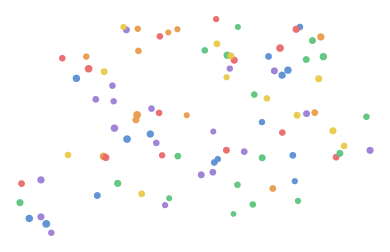
The business itself has one brain: how you think, what you've decided, what's true. Every person, every tool, and every agent works from it. It remembers, it's trustworthy, and it never contradicts itself.
It upgrades the way your phone does, getting smarter on its own whenever the technology underneath it improves. Every time AI gets smarter, your whole business gets smarter.
It's not AI bolted onto your business. It's your business, made intelligent.
One gets more chaotic every quarter.
The other gets smarter.
If you want a business that actually gets smarter every day, it needs one intelligent brain. So what actually changes when a business gets one? Start with the part nobody saw coming.
Services Just Became One Of The Best Businesses To Scale.
Because an intelligent business doesn't just know what you know. It does something with it. A client emails, and the reply that goes back is your reply: your standards, your voice, your judgment, and you never touched it. The follow-up that always slips? Sent. The first draft that eats your Sunday? Sitting in your review queue Monday morning with its sources attached.
Your Brain
Frameworks, methodology, voice, judgment
Agent and Team Seat Layer
Governance and Permissions
Client One: An Isolated World
Their files, history, and decisions in one secure, AI-native brain
Client Two: An Isolated World
Their files, history, and decisions in one secure, AI-native brain
Client Three: An Isolated World
Their files, history, and decisions in one secure, AI-native brain
Decisions Flow Back
What you approve is remembered and applied back to the brain.
Your Rules, Enforced
Every seat operates inside the permissions you set.
You Approve, You Never Assemble
What you decide goes back into the brain, and every seat works from it next time.
Outcomes, Not Tasks
Sources Attached
And the market is moving toward you, not away. What commands a premium now is how personally your business can serve each client, at a cost the old way of working can't touch. Personalization is the new scarcity. And personal requires knowing: the client, the history, the standards. That's a brain.
The expertise is yours. The delivery just got cheap. The only thing standing between you and that upside is whether your business can hold it without you personally carrying every piece.
This Is Intelligence as a Service.
Your judgment, running as infrastructure. Held in one brain, applied to every client,
executed by team members and agents that answer to you.
Service as Labor
The old model, the one you are in now.
Every new client is paid for with your calendar, and the margin thins as you grow. Growth stops where your week does.
Revenue capped at your hours
Intelligence as a Service
The new model, the one this page is naming.
Every new client is served by the brain, to your standards, in your voice. Margin compounds. Your hours stay flat.
Margin compounds · hours flat
The old model had a name too, even if nobody said it out loud: service as labor. Your knowledge was the product, but your hours were the package, so your calendar was the factory. That model just died, not because your knowledge lost its value, but because the labor around it did.
Look at what's actually left standing. In a world where AI can do the tasks, the only thing still uniquely valuable is intelligence: knowledge, maintained and processed and applied, plus the discernment to know what good looks like. You have a decade of exactly that. It's the one asset a twenty dollar subscription cannot print.
So the model flips. You stop selling hours. You stop packaging your thinking inside your labor. Clients buy access to how you think, and your business delivers it: personally, precisely, at a scale your calendar never allowed. Add a client, and the thing that grows is profit. Not your hours.
The day-to-day changes shape with it. You spend your time where humans still win: relationships, judgment, deals. You talk with your AI, you decide, you direct. The business does the rest. That's not a fantasy about some distant future. That's just what an intelligent business looks like on a Tuesday.
Freelancers sell time. Software sells tools. You'll sell intelligence.
This isn't a prediction. It's already happening, and it's moving fast. The businesses that make this shift early will set the prices everyone else reacts to. Which leaves one practical question: your judgment can't execute itself. Something has to do the work. That's where agents come in.
10 minutes · free · know your first agent
You Don't Delegate Tasks Anymore.
You Delegate Outcomes.
The agent economy isn't coming. It's just suddenly here. Nobody voted for it.
Nobody opted in. The only question is how you participate.
Agents, and what they run on
Outcomes, not tasks
Your Intelligent Brain
Your standards, your clients, your judgment. What good looks like.
Follow-up agent
No lead or client thread goes cold.
Reporting agent
Every client update, drafted in your voice.
Onboarding agent
Signed to started in a day.
A generic agent
Fast, confident, and wrong. The same twenty dollar output already flooding your market.
Every action on the record
Nothing goes out without your approval
For your whole career, delegation worked one way: you figured out the how, every step, then handed it to a person or did it yourself at eleven at night. Agents flip that. You name the outcome, no lead ever goes cold, every client gets their update on Friday, and the agent owns the doing. Soon, every business will have them.
But here's what the agent economy won't tell you: an agent is only as good as the intelligence it runs on.Delegating an outcome is only safe when the one doing the work knows what good looks like. An agent without your brain is the worst hire you've ever made: fast, confident, and wrong.
Every bad agent story you've heard? That's not an agent problem. That's a brain problem.
Your agents need a brain.
The best one to give them is your own.
There's a name for the layer that makes that possible.
Meet Client Intelligence, The Brain
Your Business Runs On.
Your business brain
The brain
Methodology, memory, decisions, taste
Team Seats
Controlled access
Clients
Scoped workspaces
Projects
Delivery system
Frameworks
Business IP
Documents
Source truth
Decisions
Recall layer
Entities
Relationship graph
Artifacts
Durable output
Everything plugs into one brain
Building a brain sounds simple: store the knowledge, add AI. It isn't. A real business brain is permissions, authority, and governance.Which facts are law and which are just notes. Contradiction resolution, so the business never disagrees with itself. A gate, so nothing becomes memory without passing it. And coordination: humans and agents working from the same truth without stepping on each other. That's why the AI industry sold you tools instead. Tools are easy to ship. The brain is extremely hard to build. We built it because we had no choice.
The brain:it interviews you, out loud, a real conversation, and writes your thinking down. It remembers every decision word for word, and enforces the ones you lock. And because AI tools don't know what a client is (they know users and chats), every client here gets their own sealed world, with your methodology flowing in automatically. Nothing leaks between clients. Ever.
The hands: any agent that works for you runs on your brain, sees only what you allow, and waits in your approval queue before anything changes. Every action, on the record.
And before it ran anyone else's business, it ran mine. We moved 90% of our own operation onto Client Intelligence in the first month. Not because we had to. Because it worked better than what we were doing before.
Every Intelligent Business Starts With
One Agent. Find Yours.
So agents are here whether or not you wanted them. That part is easy to agree with. The hard part is the next question: which one?
Get that wrong and you already know exactly how it goes, because you lived it with tools. You pick the agent that looked impressive in a demo, point it at a business that never wrote anything down, and it produces fast, confident, generic work that isn't yours. You end up right where the tools left you: more output, less trust, and more of you checking everything. That is what happens to most people who rush into agents, the same way it happened to most people who rushed into AI.
Get it right and it's a different business. One agent, pointed at the one thing that actually eats your week, running on your standards. That is the whole difference between the handful of people quietly winning with AI and everyone else. They didn't adopt more AI. They picked the right first agent and gave it a brain.
Which is exactly why we built the Agent Analysis Starter Pack: the on-ramp to Intelligence as a Service. Find out which agent to build first, before you spend a dollar or a weekend on the wrong one.
Free · 10 minutes
The Agent Analysis Starter Pack
Find out exactly which agent you should build first for your specific business, and what it takes to finally get the results you actually want. All free.
Here is everything you walk away with.
The Agent Analysis Interview.A 10-minute conversation with the platform about how your business actually runs: where the time goes, where the leverage hides, what only you can do. No forms. No prep. You just talk.
Your First-Agent Prescription.A written analysis naming the one agent that would pay for itself first: what it would own, and what it would need to know to do it your way. The kind of diagnosis you would pay a consultant four figures to work out manually.
The Agent Game Plan Call.If your prescription looks like a fit, we map it with you live: what your first agent does, what it runs on, and what it changes in your week. You leave with a plan, not a maybe.
First-agent prescription
Your Prescription · Hire This One First
The Reporting Agent
Named from your own words, in about ten minutes.
Why this one
It owns the eleven hours a week you spend personally writing client updates, and it is the one place your voice is already written down.
What it owns
4 workflowsWhat stays yours
Approval, pricingWhat it needs to know
6 inputsWritten from your own words
Free
Your prescription, yours to keep
What a first agent looks like.
Maybe it's a follow-up agent that never lets a lead or a client thread go cold. A reporting agent that drafts every client update in your voice, receipts attached. An onboarding agent that takes a new client from signed to started in a day. Yours gets named from how your business actually runs, which is exactly what the interview finds out.
This is for you if
You run a client business on your own expertise, and you're done duct-taping tools together.
It's not for you if
You just want cheap AI output. A twenty dollar subscription already does that.
Why free? Honestly: because it's how we find the businesses worth building agents for. Some of you will read your prescription and sit on it. That's fine, it's yours. And some of you will see your first agent on paper and want it real. That's the First Agent Install: we build your first agent with you, running on your business's brain from day one, with your approval queue over everything it does. That's the business we're in.
Get Your Agent Analysis Starter Pack10 minutes · free · know your first agent
Skeptical? Good.
"But AI Forgets. It Hallucinates. It Can't Be Me. It's Not Secure."
Fair. Maybe you even like AI. Maybe you've built a few workflows. And you still hit the same ceiling: letting it run loose on real client work feels reckless. That instinct is correct. So here are the objections I hear most, and the honest answer to each.
"It forgets everything."
Decisions are cited back word for word, this Friday or next quarter. Lock one and the platform blocks work that contradicts it.
"It makes things up."
Every client-ready answer carries its receipts: its sources, its retrieval trail, its versions. When it cannot prove something, it says so instead of filling the gap.
"It could never sound like me."
You never write a prompt. It interviews you out loud, about six questions, and writes you back to yourself. Then it learns from every correction. It does not start as you. It becomes you.
"I am not technical enough for this."
Your first agent gets built with you, not handed to you. If you can talk about your own business for ten minutes, you can do this.
"My clients’ data. Is this thing training on my business?"
Sealed client workspaces, by architecture. Scoped access, approval before any write, and your data never trains external models. Your brain stays your intellectual property.
Notice that every one of those answers is the same answer. None of them are model problems. They are governance problems: who is asking, what they are allowed to see, what is allowed to change, and what has to be approved before it counts as true. Fragmented tools have no answer for that, which is why they fail on real client work. So that is the layer we went and built.
Governance and permissions layer
Who is asking
Reporting agent
requests write
Follow-up agent
requests send
Teammate
requests access
Outside tool
requests everything
The gate
Governance and permissions
Identity
whoScope
which workspacePermission
~300 capabilitiesApproval
your queueAudit log
on the recordOutside tool blocked. Nothing crosses.
What it protects
Business memory
Locked decisions, methodology, client truth
Client workspace
sealedClient workspace
sealedClient workspace
sealedScoped access · approval before any write
Every Claim On This Page Ran Inside Our Business First.
38%
of my clients gone by April. The collapse that forced us to build this. We rebuilt on it.
90%
of our own operation moved onto Client Intelligence in the first month, because it worked better.
~300
governed capabilities an agent can be granted. Every one locked down by default.
"It's the first AI thing that actually knows our business."
Sarah, a service provider with 22 clients, was spending 15 hours a week personally carrying client reporting and follow-up. Sixty days after installing her brain and her first agent: reporting drafts wait in her approval queue every morning, her delivery hours are down 40%, and she onboarded her newest client in a day instead of a week, with every client's data sealed in its own workspace.
Sarah · Service provider, 22 clients
Six Months From Now, One Of Two Mondays Arrives.
Here's the part that makes this urgent, and it isn't a countdown timer. Doing nothing used to mean coasting. You could maintain for years. Not anymore. If your business runs through your head, you're not holding steady, you're already trending underwater, because the water is rising on a schedule you don't control. The gap between the two kinds of businesses compounds every single day.
Monday, 7:04 AM. You open the laptop.
Re-teaching the AI what it knew on Friday
20 min“Didn't we decide this in March?”
You think you rememberMonday, 7:04 AM. You open the platform.
Three client updates, drafted overnight in your voice. Sources attached.
Two clients need you today. The rest is handled.
Prioritized“Didn’t we decide this in March?”
Cited word for wordLast week's follow-ups
Sent · on the recordSame date. Same you. The only variable is what the business runs on.
Without Client Intelligence
Another Monday. You open your laptop and try to remember where you left off with each client. You check Notion. You check Drive. You open Claude and paste in some context because the last conversation is gone. You spend 20 minutes getting the AI back up to speed on something it should already know.
A client asks about a decision you made together six weeks ago. You dig through notes. You think you remember. You're not sure.
And here's the quiet truth about this Monday: next month's version of it is a little worse. A little more chaotic, a little more to review, a little more of you spread across a little more. It's not a plateau. It's a slope.
With Client Intelligence
You open the platform and it shows you which clients need attention today. An agent finished a draft overnight. It's in your approval queue with its sources attached. You read it, tweak one line, approve it, move on.
A client asks about that decision from six weeks ago. You pull it up in seconds. Word for word. They're impressed. You didn't even have to think about it.
And next month's version of this Monday is a little better. A little more systemized, a little more handled, a little smarter, because every week the brain learns and every AI upgrade upgrades your whole business. You're not the only brain in your business anymore. And you're excited about the future again.
The Questions You're Already Asking.
No. It's a 10-minute conversation with the platform, not a person, and you get the full analysis whether or not we ever talk. No card, no commitment. If your recommendation looks like a fit and you want to explore it, we'll review it together on a call. That part is entirely up to you.
You get it in writing: the agent to build first, why it fits your business, and what it needs from you to run. Then a Game Plan Call to map the install, if you want one. The analysis is yours either way. No card, no commitment.
We moved 90% of our own business onto Client Intelligence in the first month. Not because we had to. Because it actually worked better than what we were doing before. We spend less time per client and deliver more than we ever could because the platform holds the full picture.
It will at first be close. Then over time, through the feedback loops and the voice interactions and the way it learns from every decision you make, it becomes nearly indistinguishable. Not AI pretending to sound human. Actually your voice. Your way of thinking. Your frameworks.
Those tools don't know what a client is. They don't isolate data between workspaces. They don't apply your methodology across contexts. They don't remember your decisions three months later. They're powerful general tools. Client Intelligence is built specifically for people who manage clients.
Every client workspace is fully isolated. No data crosses between workspaces. No other client's information can appear in another client's outputs. It's separated by architecture, not by prompting.
Google Calendar, Gmail, Google Drive, Notion, GitHub, Slack, Zoom, and growing. The platform is designed to be where you work, not another tab you have to check.
You Didn't Build Your Business To Manage AI Tools.
You built it because you're good at what you do. Because you see things other people don't. Because your clients trust you with their business, and you take that seriously. "Do you see a man skilled in his work? He will stand before kings." That's who this is for: the people who do genuinely good work, who make the people they serve better, and who deserve infrastructure as good as their judgment.
Client Intelligence doesn't replace you. It makes sure the way you think stops being trapped in your head, and starts being the most valuable asset your business owns.
We have a name for what we're for. Get paid. Be free. Get paid for what you know, not for the hours it takes to deliver it. Be free of being the only place your business's brain lives. It was never supposed to be a choice between the two.
This is Intelligence as a Service. You spent a decade building the intelligence. We built the service.
Your business should be as smart as you are. Now it can work as hard as you do.
Ten minutes gets you all three: the Interview, your First-Agent Prescription, and a Game Plan Call to map the install.
Get Your Free Agent Analysis10 minutes · free · know your first agent
P.S.If you scrolled straight here: AI changed the rules, your business's brain is fragmented, and that combination is why AI hasn't worked for you. Bolting on more tools speeds up the chaos. The way out is an intelligent business: one brain, with agents that do the work. That's Intelligence as a Service, and the on-ramp is free. Find out which agent your business should build first.